Reverses partway up
The door starts up, gets partway, and reverses back down on its own. Or the motor runs - you can hear it - but the door doesn't go anywhere, which usually means the drive gear or belt has let go inside the housing.
Johns Creek, GA
Opener grinding, reversing, or dead on arrival? We fix garage door openers across Johns Creek's 1980s-90s housing stock, built for a cold-moderate climate.
Warning signs
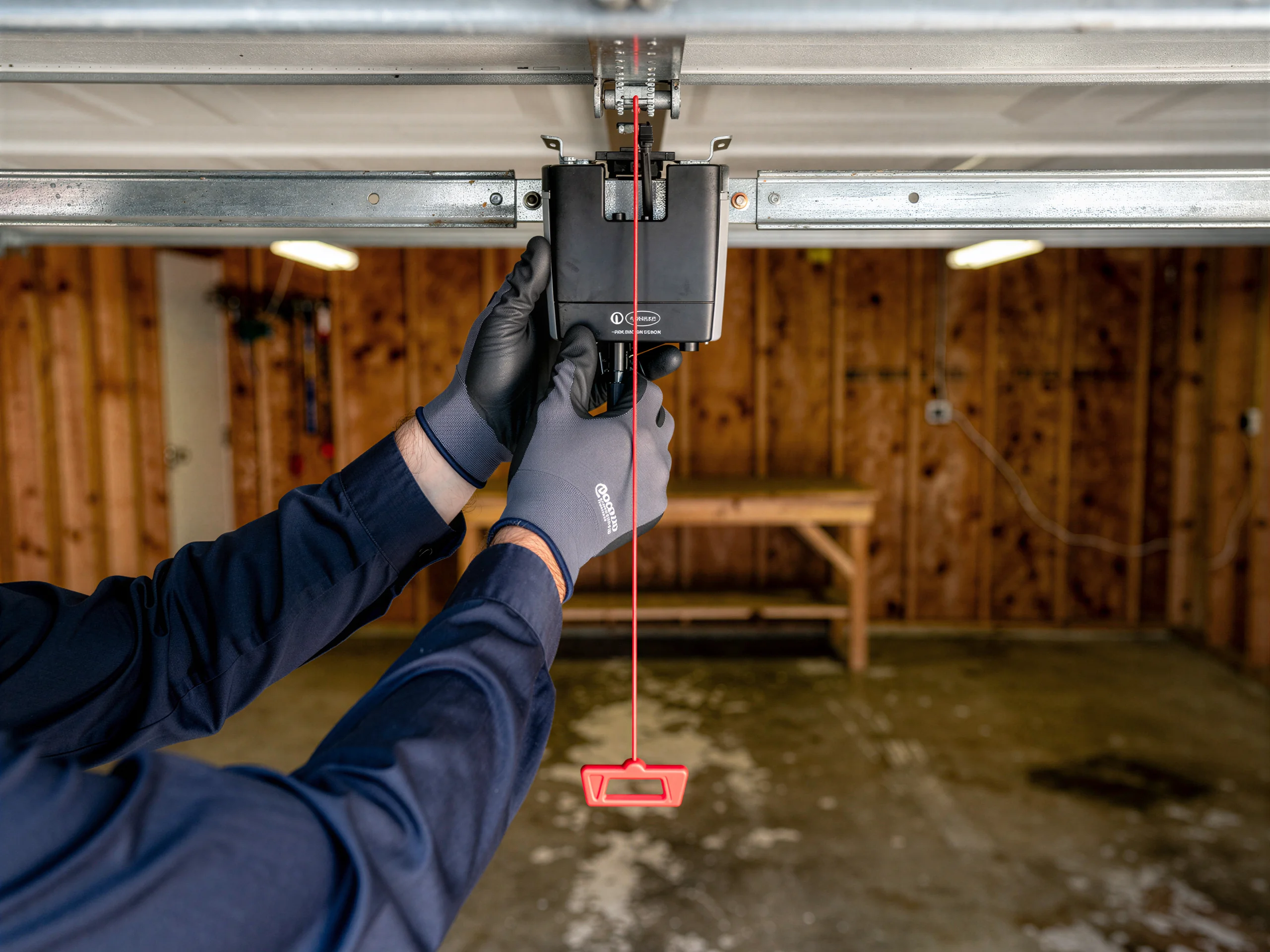
Most opener calls come in one of three ways. The door won't move at all and the light on the unit either doesn't come on or blinks a code.
The door starts up, gets partway, and reverses back down on its own. Or the motor runs - you can hear it - but the door doesn't go anywhere, which usually means the drive gear or belt has let go inside the housing.
A remote that stopped working from the car but still works standing next to the unit points at the antenna or the logic board, not the motor. A door that only reverses in cold weather points at the force settings drifting as lubricant in the drive stiffens.
If the opener runs hot to the touch and trips a thermal shutoff after a few tries, that's a motor working harder than it should, usually because the springs are no longer carrying their share of the door's weight. Houses across this part of the service area were built between 1951 and 2012, with the bulk going up in the 1980s and 90s.
That median build year matters here: a lot of original chain-drive units installed when those houses went up are now thirty-plus years into service, and the failure pattern we see tracks that age, not the brand name on the housing.
Our process
We start at the unit, not the door. Logic board, capacitor, drive gear, limit switches, safety sensors - in that order, because a bad safety sensor will mimic a dead opener and send people straight to a motor replacement they didn't need.
If the drive gear or belt is stripped, that's a part swap, not a full unit. If the board has failed, we check first whether the chassis and motor are worth keeping - on a unit from the 1980s or 90s building wave, sometimes they are, sometimes the housing is cracked and the bearings are shot and a new board is money into a dying machine.
Force and travel limits get reset by hand, not just by running the default setting, because a door that's picked up slack in its cables over the years needs different numbers than it did new. We test the auto-reverse safety with a real obstruction, not a visual check, before we call the job done.
One limitation worth saying plainly: if the opener is a direct-drive or belt unit tied to a proprietary board that's been discontinued, parts lead time runs longer than a standard chain-drive replacement part, and we'll tell you that up front rather than promise a same-visit fix we can't deliver.
Pricing
We're not going to put a number here that doesn't hold up once a tech is standing in your garage, because opener repair cost swings hard depending on what's actually wrong.
A capacitor or logic board swap on a working motor is a different job than a full motor-and-rail replacement, and a unit that's also fighting worn springs costs more to fix right than one that isn't. What we can tell you is what drives the number: whether the chassis and motor are salvageable, whether the board is a stock part or a special order, and whether the springs need attention at the same time - which they often do on a door where the opener has been straining for months before it finally quit.
Across the service area, with 44,786 owner-occupied houses and a median household income of $91,308, most of the calls we take are from owners dealing with original or first-replacement hardware rather than a brand-new install gone wrong.
That shapes the kind of repair we quote: more rebuild-and-restore, less warranty callback. We give a firm number after we've looked at the unit, not before, and we'll say so if replacing the opener outright beats patching a board that's near the end of its run.
Local causes
Johns Creek sits in a cold-moderate climate band, which means winters cold enough to stiffen grease in the drive and chill the capacitors that start the motor, but not cold enough that anyone insulates a garage for it. That combination - real cold, no real preparation for it - is exactly where opener failures cluster in January and February: the motor draws more current to overcome stiff gearing, the capacitor that's already weak from age can't deliver the extra push, and the unit trips out.
The housing stock compounds it. With most houses across the 23 named areas we track dating to the 1980s and 90s, and the overall range running 1951 to 2012, a large share of openers in service right now are original equipment well past the point where a logic board or capacitor is expected to last. Nobody replaces an opener on a schedule - they replace it when it quits - so the age of the housing stock tells you roughly how many units out there are due, not which ones.
Proximity plays a role too. Johns Creek sits close to Berkeley Lake, four miles off, and Peachtree Corners at five, part of a tight cluster of built-out suburbs rather than one town sitting alone - which is part of why this is a parent service page covering opener repair across the wider area instead of just one street.
Questions
Grease in the drive gear and belt stiffens in cold weather, which makes the motor work harder to move the door. If a capacitor is already weak from age, that extra load is enough to trip a thermal shutoff or stall the door partway. It's rarely a coincidence - cold exposes a motor or capacitor that was already close to failing.
Depends on what's failed. A stripped drive gear or dead capacitor on an otherwise sound chassis is worth fixing. A cracked housing, worn bearings, or a board that's discontinued usually isn't - you'd be putting new money into an old frame. We check the chassis condition before quoting either way.
No. That pattern almost always points to the antenna or the receiver board inside the unit, not the motor or drive. The door moving fine when you press the wall button confirms the motor's fine - it's a signal problem, and usually a cheaper fix than people expect.
For standard chain-drive units, usually yes. For belt-drive or direct-drive units tied to a discontinued proprietary board, lead time runs longer, and we'll tell you that before you commit to a repair rather than after.
Explore more
Ready when you are
Johns Creek Garage Door Pros repairs and installs garage doors, springs and openers in Johns Creek, GA and the surrounding area.